Most designers think their portfolio is a place to showcase everything they have ever created. It feels personal. It feels like proof of effort. But the uncomfortable truth is this: your portfolio is not a scrapbook. It is a decision making tool.
When someone opens your portfolio, they are not asking, “Is this person talented?” They are asking, “Can I trust this person with my time, my budget, and my brand?” That is a very different question. And it requires a very different kind of presentation.
These portfolio tips for designers are not about making things prettier. They are about making things clearer, sharper, and more strategic.
Quality Over Quantity Is Not Just a Cliché
You will hear “quality over quantity” everywhere, and most designers nod in agreement while still uploading 14 projects.
In reality, a strong portfolio is usually compact. Five to eight well chosen projects are more than enough to communicate skill and direction. When a portfolio contains too many projects, something almost always slips in that weakens the overall impression. One average project among strong ones can quietly lower the perceived level of the entire body of work.
Editing is uncomfortable because it forces you to detach emotionally from past work. But discipline is visible. A tightly curated portfolio signals confidence. It says you understand what matters and what does not.
It also helps to think about sequence. The first project someone sees shapes their expectation. The last one shapes their memory. If your strongest work is buried in the middle, you are making people work too hard to discover your value.
Decide What You Want to Be Known For
Another one of the most important portfolio tips for designers is clarity of direction.
Your portfolio is not neutral. It actively shapes your future opportunities. Whether you aim to work independently or within a larger structure, understanding the difference between a branding agency vs freelance designer model can help you curate work that matches your intended career path. If most of your work showcases branding, you will likely be approached for branding. If your portfolio leans heavily toward social content or small layout tasks, that becomes your perceived level.
Before you even begin curating, it is worth asking yourself what kind of work you actually want more of. If you are building toward future relevance, studying emerging graphic design trends in 2026 can help you align your portfolio with where the industry is heading rather than where it has already been. The projects you highlight become a signal. They tell people what you stand for and what problems you are comfortable solving.
There is no universal rule about being niche or diverse. Early in your career, showing range can communicate adaptability. Later on, focus tends to communicate authority.
What matters most is cohesion. Even a diverse portfolio should feel like it belongs to one designer with a clear mindset, not five different personalities stitched together.
Context Is More Powerful Than Aesthetic
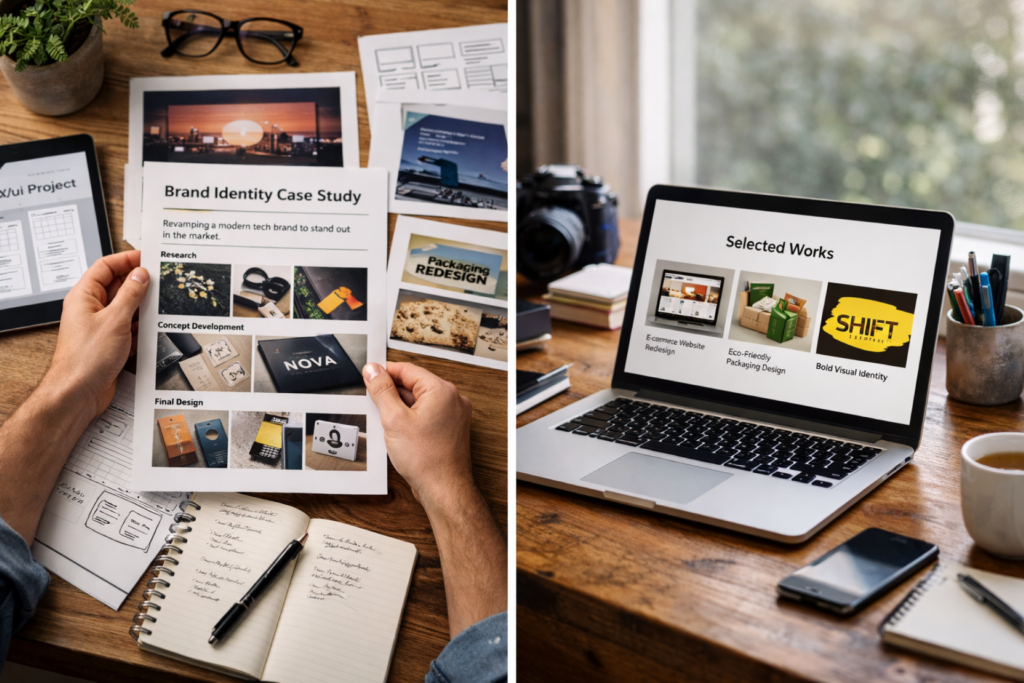
What gives a project weight is context. When someone understands the problem behind the design, the constraints you were working under, and the reasoning behind your decisions, the work becomes more than decoration.
Instead of presenting a logo floating on a clean background, show where and how it lives. Instead of a single app screen, demonstrate how the interface flows and solves a user need. Instead of isolated packaging visuals, show the product in a realistic environment.
When you provide context, you are not just showing design skills. You are demonstrating that you understand business, users, and systems. That is what makes hiring managers lean forward.
Tell the Story Behind the Work
Storytelling does not mean writing long essays. It means guiding the viewer through the journey of a project. What was the brief? What was the tension? What made the problem challenging? What insight shifted the direction? How did the solution emerge?
The strongest portfolios explain why decisions were made, not just what was created. When you describe your choices, focus on reasoning. For example, instead of saying you chose a bold typeface because it looked modern, explain that the client needed stronger visibility in a crowded retail environment and that the typographic direction increased readability and impact.
That shift from aesthetic description to strategic explanation is where portfolios start to feel senior.
Present With Confidence and Space
Overly busy layouts, heavy animations, or dramatic transitions often distract from the content. Simplicity is not boring. It is confident. Large imagery, generous spacing, and clear hierarchy allow the work to breathe and speak.
When portfolios are reviewed, they are often scanned quickly. Clarity helps your work land instantly. The goal is not to impress with interface tricks. The goal is to remove friction between the viewer and your thinking.
Below is a simple comparison that highlights the difference between thoughtful presentation and common mistakes.
Strong vs Weak Portfolio Presentation
| Aspect | Strong Portfolio | Weak Portfolio |
|---|---|---|
| Project Count | 5 to 8 carefully selected projects | Large mix of strong and average work |
| Layout | Clean, spacious, focused | Crowded, visually noisy |
| Case Studies | Clear narrative with reasoning | Image dumping without context |
| Copy | Concise, purposeful explanations | Generic, vague descriptions |
| Performance | Fast and responsive | Heavy animations that slow loading |
| Direction | Cohesive and intentional | Random and inconsistent |
Show Process, But Curate It
There is value in revealing how you think. Sketches, iterations, and exploration can add credibility. But the process needs editing just as much as final outcomes.
The point of showing process is to demonstrate problem solving. It should highlight key turning points or insights that shaped the solution. Uploading every version and every rough draft does not communicate depth. It communicates lack of curation.
Selective process documentation shows maturity. It tells the viewer that you know what is important and what is noise.
Demonstrate Impact Whenever Possible
One of the most persuasive portfolio tips for designers is to connect work to results.
If you can show measurable impact, such as improved engagement, increased conversions, or clearer positioning, your portfolio becomes stronger immediately. Numbers make abstract design decisions tangible.
Even when precise metrics are not available, you can still describe impact in meaningful ways. Perhaps a rebrand helped clarify a company’s message, align internal teams, or attract a new target audience. Framing your work in terms of outcomes shows that you think beyond visuals.
Make It Personal, Without Overperforming
A short, honest introduction about who you are, where you are based, and what you care about can add warmth. The tone of your writing can reflect your personality without becoming unprofessional.
Authenticity does not require oversharing. It simply means writing in a way that feels natural and grounded. A portfolio that feels human is more memorable than one that feels manufactured.
At last, If you are positioning yourself for higher level clients or aiming to work with a professional branding agency in Dubai, demonstrating measurable results becomes even more critical. Agencies and enterprise clients evaluate designers based on business impact, not just visual appeal.
Use a Practical Framework to Review Your Portfolio
It can be difficult to judge your own work objectively. The following checklist can help you evaluate whether your portfolio is aligned with best practices.
Portfolio Self Evaluation Checklist
| Question | Yes | No |
|---|---|---|
| Does my portfolio include only my strongest 5 to 8 projects? | ||
| Does each project clearly explain the problem and reasoning? | ||
| Does the work reflect what I want to be hired for in the future? | ||
| Is the layout clean and free from distractions? | ||
| Do I show context, not just isolated visuals? | ||
| Have I included measurable or clearly defined outcomes? | ||
| Is the portfolio easy to navigate on mobile and desktop? | ||
| Does the overall direction feel cohesive and intentional? |
Final Thoughts
Strong portfolios are built through intention, not accumulation.
The best portfolio tips for designers ultimately come down to clarity. Be clear about your direction. Be clear about your thinking. Be clear about your value.
When someone finishes reviewing your portfolio and feels confident in your ability to understand problems and deliver thoughtful solutions, you have achieved its purpose.
If you are serious about building a portfolio or brand that stands out for the right reasons, it is time to approach it strategically. Connect with Erahaus and let’s build work that is not only visually strong, but commercially powerful and future ready.
FAQ
How many projects should a designer include in a portfolio?
Most experienced professionals recommend between five and eight projects. This range allows you to demonstrate range and depth without overwhelming the viewer or diluting quality.
Is it acceptable to include personal or student projects?
Yes, especially early in your career. Personal projects can be powerful if they demonstrate real thinking, constraints, and problem solving rather than purely aesthetic exploration.