
Service business website pages should do more than fill a navigation menu. They should explain what the business offers, build trust, support SEO, guide visitors through a decision, and make it easy to inquire. For Dubai service businesses, the right page structure can make the difference between a website that looks complete and a website that actually generates leads.
A strong service website is not one page trying to do everything.
It is a structured set of pages where each page has a role: explain, prove, rank, guide, or convert.
Why Page Structure Matters for Service Businesses
Service businesses often lose leads because their websites are too thin or too vague. A homepage may mention every service briefly, but users still need detail before they inquire. Search engines also need dedicated pages to understand what the business offers and which topics each page should rank for.
The right service business website pages create a clear journey. Visitors can understand the offer, compare service options, review proof, learn the process, answer objections, and contact the business when they are ready.
This is why page planning should be part of website development, not something added after the design is finished.
Short Answer: What Pages Should a Service Business Website Have?
A service business website should usually have a homepage, individual service pages, an about page, work or case studies, testimonials or proof, a process page, contact page, FAQ section, landing pages where needed, and a blog or resource hub. The exact service business website pages depend on the offer, audience, location, and sales process.
The Essential Service Business Website Pages
Homepage
The homepage should explain who the business helps, what it offers, why it is credible, and where visitors should go next. It should not carry the full weight of every service detail.
Core Service Pages
Each important service should have its own page. Dedicated service pages improve clarity, SEO targeting, internal linking, and conversion because users can read about one specific offer without distraction.
Industry or Audience Pages
If the business serves different industries or audience types, separate pages can make the offer more relevant. For example, a consultancy may need pages for startups, enterprise clients, or specific sectors.
About Page
The about page should build trust, not just tell a company story. It can explain expertise, values, team background, operating style, and why the business is qualified to solve the client's problem.
Contact Page
The contact page should make action easy. Include a simple form, contact details, location context if relevant, response expectations, and a clear explanation of what happens after inquiry.
Proof and Decision Pages That Help Visitors Trust You
The basic pages explain what the business does. Proof and decision pages help visitors believe it. These pages are especially important for service businesses because buyers are often evaluating expertise, reliability, fit, and risk before they inquire.
Work, Case Studies, or Portfolio Page
Show what the business has done and how it thinks. This page gives prospects evidence before they speak to the team.
Testimonials or Proof Page
Testimonials, reviews, recognitions, client logos, and measurable proof can reduce hesitation when placed near service and contact paths.
Process Page
A process page explains how the engagement works. It is useful when buyers need to understand steps, timelines, responsibilities, and what to expect after inquiry.
Pricing or Packages Page
Not every business needs public prices, but many should provide pricing context, scope factors, package ranges, or qualification guidance to improve lead quality.
Content and Growth Pages
Some service business website pages are built for long-term growth rather than immediate conversion. These include blogs, resource hubs, FAQs, comparison pages, and targeted landing pages. They help the website answer more search queries and guide users at different stages of decision-making.
For lead generation, effective landing pages for lead generation can be built around specific campaigns, services, audiences, or offers. They should focus on one decision path instead of behaving like a general homepage.
Service Business Website Sitemap Model
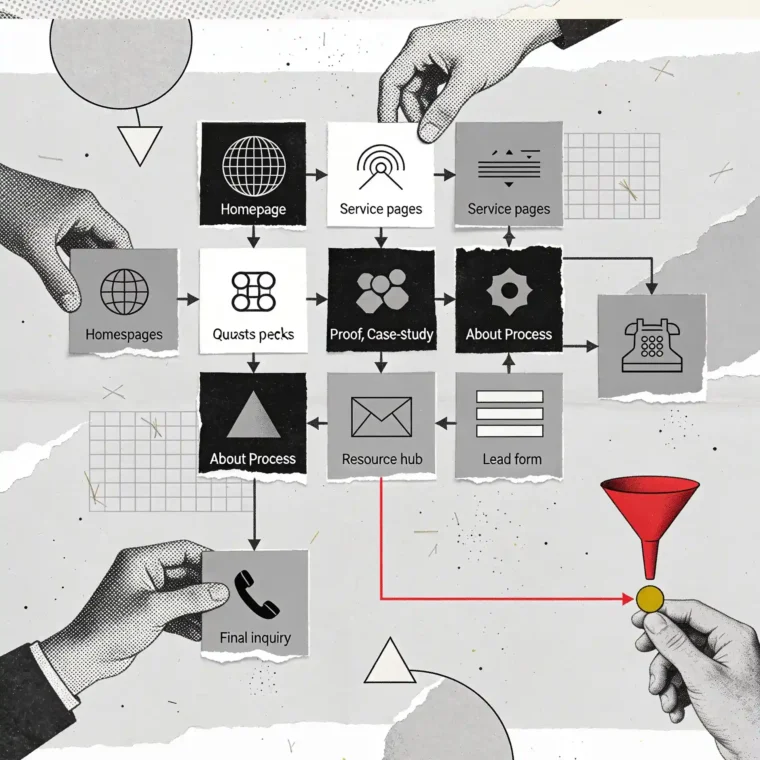
A clear sitemap helps both users and search engines understand the website. The model below shows how the essential pages can fit together.
Simple service website structure
This structure should be supported by user-friendly website navigation and a clear internal linking strategy for business websites. Navigation helps users move through the main page groups, while internal links connect related pages inside the content.
Interactive Page Priority Guide
Not every service business needs every page on day one. Use these scenarios to decide which pages to prioritize first.
If you are launching a new service business
Start with homepage, core service pages, about page, proof section, and contact page. Add process, FAQs, and blog content once the basic conversion path is clear.
If you already get traffic but few leads
Prioritize service pages, proof pages, process content, stronger CTAs, and contact flow. Review website conversion optimization before adding more traffic-focused pages.
If you want stronger SEO growth
Prioritize dedicated service pages, location pages if relevant, comparison content, FAQ content, and a resource hub. These pages should support SEO techniques for lead generation.
Pages That Are Often Missing but Important
Many service websites include the obvious pages but miss pages that improve trust, tracking, or lead quality. A thank-you page can help track conversions after form submission. A dedicated landing page can support a campaign. A location page can help local relevance. A strong FAQ section can answer objections before a sales call.
Before launch, use a website content checklist before launch to confirm each page has the right copy, proof, CTAs, images, metadata, and internal links.
How These Pages Support SEO and Conversion
Service business website pages support SEO by giving each important topic, service, and intent its own clear destination. They support conversion by matching the page to the visitor's question. A homepage can introduce the business, but a dedicated service page can answer deeper buyer questions.
This is also why page structure should connect to conversion strategy. If users land on a service page, they should see the offer, proof, process, objections, and CTA without needing to search around the site.
External Standard: Make Pages Useful and Easy to Find
Google's SEO Starter Guide reinforces the value of creating helpful content and organizing pages so users and search engines can understand them. That principle applies directly to service website structure: every important service should be easy to find, understand, and act on.
Final takeaway
Service business website pages should create a clear path from first impression to qualified inquiry. A strong website does not rely on one homepage to explain everything. It uses dedicated pages to answer specific questions, build trust, and support search visibility.
For Dubai service businesses, the essential structure is simple: explain the offer, prove credibility, guide the user, and make contact easy.
Explore Website Development Website Conversion Optimization